
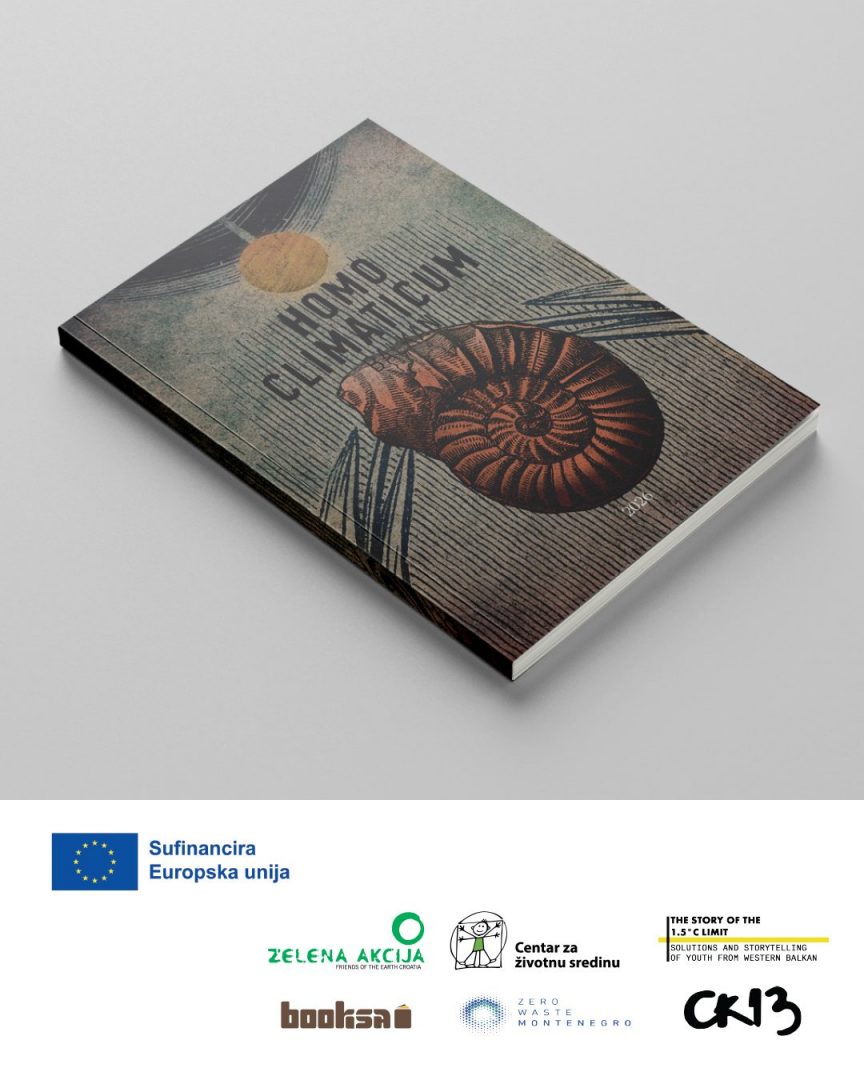
“Homo Climaticum: Balkan” is a unique regional collection of stories and poems that brings us closer to the authentic perspectives of those living through the climate crisis, while also living in the Balkans. Created as part of the European STORY project, dedicated to amplifying young people’s voices, this collection is more than just a compilation of stories and poems—it is a testimony and a manifesto of a generation taking responsibility for the future of our planet.
There is a good reason why the name of this collection is deliberately grammatically incorrect. Homo Climaticum is not a mistake; it is a manifesto. The climate knows no gender, no species, and no borders; it encompasses everything and changes us all. The new entity we have attempted to name cannot be confined within the boundaries of established grammar, just as the consequences of climate change cannot be so easily tamed. The 2026 edition has become regional, focusing on the countries of the Western Balkans as the immediate neighbours of the wider Mediterranean region—the most pronounced climate hotspot in all of Europe.
Invited to imagine the worlds that are coming (or perhaps have already arrived), authors from Banja Luka to Niš, from Mostar to Podgorica, and from Split to Belgrade responded to the call. As many as 130 stories and poems from across the region were submitted to the competition, written by authors born over a span of half a century. Of the 28 published works, as many as 12 are by young authors between the ages of 18 and 30. What unites them all is a shared feeling: that we are living within change, rather than before it.
A Regional Context and Voices That Do Not Get Lost in the Statistics
According to Đorđe Majstorović, the editor of the collection:
“The Balkans have a particular relationship with climate change. The region did not cause it to the extent that wealthier and more powerful economies did, yet it will face its consequences on an equal footing with everyone else. Our collection speaks to this injustice through the magical realism of the Istrian basin, which transforms into a mirror of conscience; through a post-apocalyptic Banja Luka where, even on the eve of the end of the world, the same old divisions resurface; and through a scorching Mostar that only begins to bloom once the sun goes down. The local and the global are not in opposition here—they stand together in the same sentence.”
Regional juries recognised in the selected works what is most difficult to achieve in climate fiction: atmosphere. The four winning stories (“The Fish in the Armchair” from Croatia, “Rot” from Montenegro, “The Last Patrol” from Bosnia and Herzegovina, and “The Pool” from Serbia) differ in tone, poetics, and approach, but they are all connected by the same ability to make visible, in an intimate way, what gets lost in ominous statistics.
“You will not find green hope in this collection, pasted onto the end of a text like some kind of romantic band-aid. If there is hope, it has been hard-earned and planted in a crack in the concrete, almost in spite of everything. The authors write from within—from the heat, from thirst, from exhaustion, from worry, from empathy. That is, very likely, the most honest thing contemporary literature can do,” concludes Majstorović.
From Art to Action: A Guide for Working with Young People
To encourage new generations to engage in similar ways, the collection is accompanied by “STORIES FOR CHANGE”—a practical guide to using storytelling, creative writing, and climate fiction methodologies in working with young people.
The STORY project has demonstrated that storytelling is not merely a creative exercise, but also a way of connecting people, building empathy, and opening conversations about the future. When young people are given the tools to tell their own stories, they begin to see themselves as part of the solution.
English Translations and Regional Live Launches Coming Soon!
Alongside proudly presenting the collection in the authors’ native languages, we are delighted to announce that three winning texts from each country have been translated into English and will soon be published, giving the voices of our young authors an international platform as well.
Because real change happens when people come together, in September we will begin a series of live launch events in all the cities of the project partners: Zagreb, Banja Luka, Novi Sad, and Podgorica. Exact dates and locations will be announced soon.
Finally, we imagined this collection as having a practical purpose as well—as a document for advocacy. So, feel free to read it in parliaments, municipal assemblies, classrooms, squares, and streets. The myth of who we are is being written right now, and behind the lines that follow stand real people who carry hope.
The collection was created as part of a regional competition organised by Zelena akcija, Omladinski centar CK13, Centar za životnu sredinu, Zero Waste Montenegro, and Kulturtreger (Klub Booksa), inviting submissions of short stories and poetic forms in the genre of climate fiction in 2026.
The collection and guide were developed as part of the project “THE STORY OF THE 1.5°C LIMIT – Solutions and Storytelling of Youth from the Western Balkans”, co-funded by the European Union and the Ministry of Regional-Investment Development and Cooperation with NGOs. The views and opinions expressed are those of the authors and do not necessarily reflect the views and opinions of the European Union, the European Education and Culture Executive Agency (EACEA), or the Ministry of Regional-Investment Development and Cooperation with NGOs.