
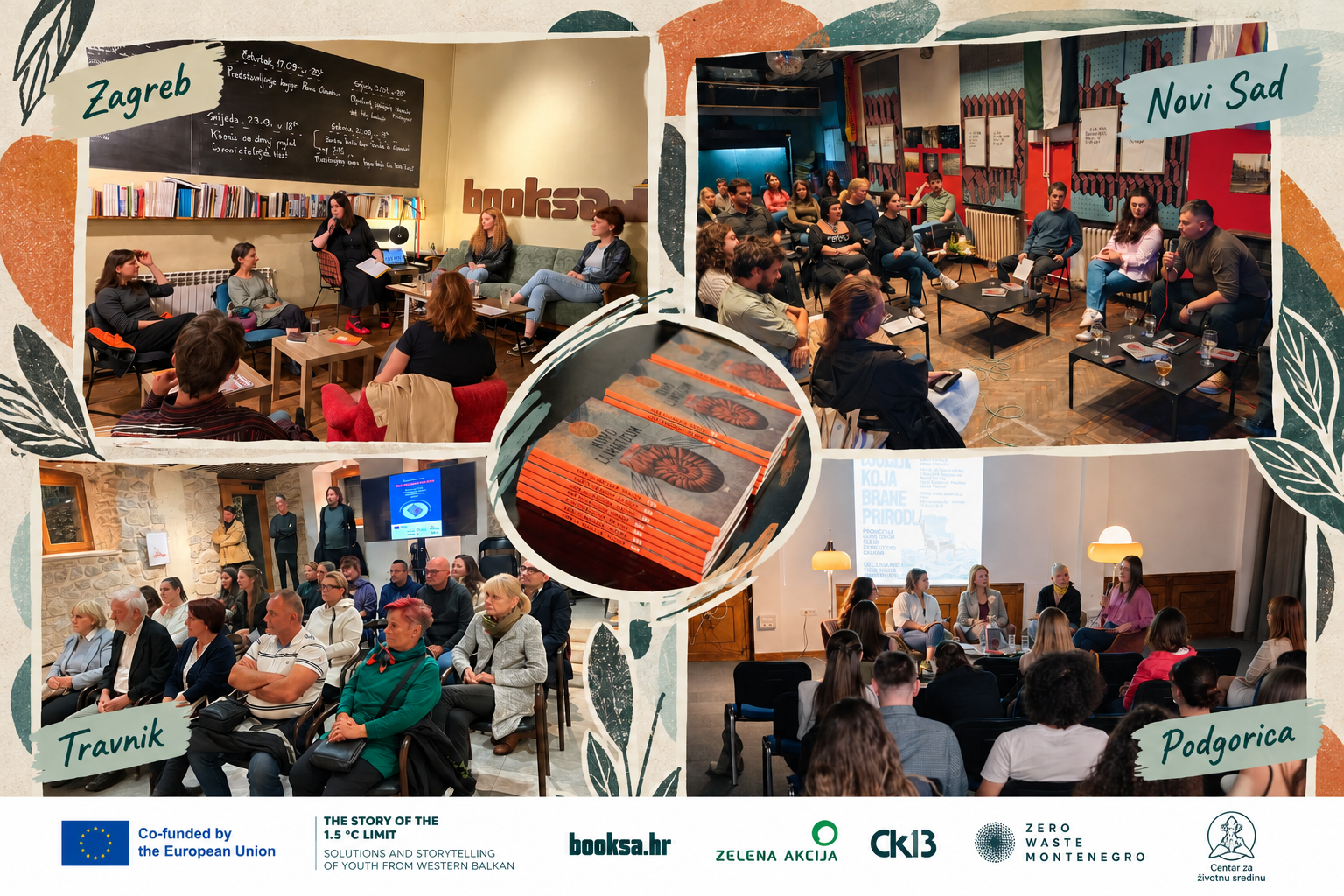
How can literature help us understand the climate crisis and inspire us to imagine a different future? This was the question we explored through four presentations of the regional climate fiction anthology Homo Climaticum: The Balkans 2026, held during September and October in Croatia, Serbia, Bosnia and Herzegovina, and Montenegro.
The events in Zagreb, Novi Sad, Travnik, and Podgorica were organised as part of the STORY – The Story of the 1.5°C Limit project and they brought together a total of 101 participants, connecting literature, climate activism, and local communities.
Four Cities, One Story About the Climate Future
The first presentation took place on 17 September at Booksa, a literary club in Zagreb, organised by Zelena akcija in collaboration with Kulturtreger. During a discussion with Anja Tomljenović, Dora Sivka, and Ivana Dražić, participants explored the development of climate fiction as a literary genre, the role of literature in understanding the climate crisis, and the possibilities of imagining different futures.
In Novi Sad, on 24 September, the presentation was organised by the CK13 Youth Centre. Particular attention was given to the authors from Serbia whose works were included in the anthology. Rebecca Duras, Tamara Janković, Angelina Životić, Predrag Momčilović, and Miloš Durković presented their works, while Đorđe Majstorović, a member of the selection jury and editor of the anthology, moderated the discussion. The audience had the opportunity to hear selected stories and poems and discuss the connection between literature, storytelling, and climate change.
The third presentation took place on 28 September in Travnik, at the Birthplace of Ivo Andrić Memorial Museum, organised by the Centre for Environment. The discussion focused on climate fiction as a literary genre, the importance of creative expression in activism, and how stories and poetry can encourage reflection on environmental and social challenges.
The regional series of presentations concluded on 7 October in Podgorica, where Zero Waste Montenegro organised the presentation at CKZ Ribnica. Alongside readings of selected literary works, a discussion was held with representatives of environmental organisations on the connection between climate fiction and environmental activism. We were especially delighted by the turnout of young people, including those who had not previously participated in environmental events.
More Than 130 Submissions and 101 Participants at the Presentations
The anthology Homo Climaticum: The Balkans 2026 was created through a regional literary open call that received more than 130 stories and poems. The selected works by authors from Croatia, Serbia, Bosnia and Herzegovina, and Montenegro explore, through imagination, emotions, and personal experiences, how climate change shapes our lives, relationships, and communities.
The four national presentations brought together 101 participants – 15 in Zagreb, 29 in Novi Sad, 25 in Travnik, and 32 in Podgorica. In addition to presenting the publication, the events created opportunities for the literary and environmental communities to meet, exchange perspectives, and engage audiences who may not usually encounter climate issues through traditional forms of environmental activism.
The Stories Continue to Live On
Through these presentations, we wanted to show that the climate crisis does not have to be discussed exclusively through scientific data, policies, and statistics. Literature opens up space for emotions, personal perspectives, and imagining the future we have yet to shape.
Although the STORY project is approaching its conclusion, we hope that the stories in Homo Climaticum will continue to spark conversations, inspire new authors, and find their place in education, youth work, and future environmental initiatives.
We invite you to explore the anthology, read the stories, and share them with others!
The events were organised as part of the project “THE STORY OF THE 1.5°C LIMIT – Solutions and Storytelling of Youth from the Western Balkans”, co-funded by the European Union and the Ministry of Regional Investment Development and Cooperation with NGOs. The main goal of the STORY project is to strengthen the capacities of young people and youth organisations across the Western Balkans, enabling them to understand and advocate for solutions to the environmental crisis through civic education and art, particularly literature.